

Types of Steel Beams: I, H, S and W Beams Explained
Structural beams play an important role in homes, warehouses, bridges, equipment and other structures. However, terms such as I-beam, H-beam, S-beam and W-beam are sometimes used interchangeably. That can make choosing and ordering steel slightly confusing.
The different types of steel beams do not vary by shape alone. Flange design, dimensions, weight, steel grade and connection details also affect how a beam works within a construction project. Here is what to know about the main beam terms, how to read a beam designation and what information to confirm before you place an order.
What Are the Parts of a Structural Steel Beam?
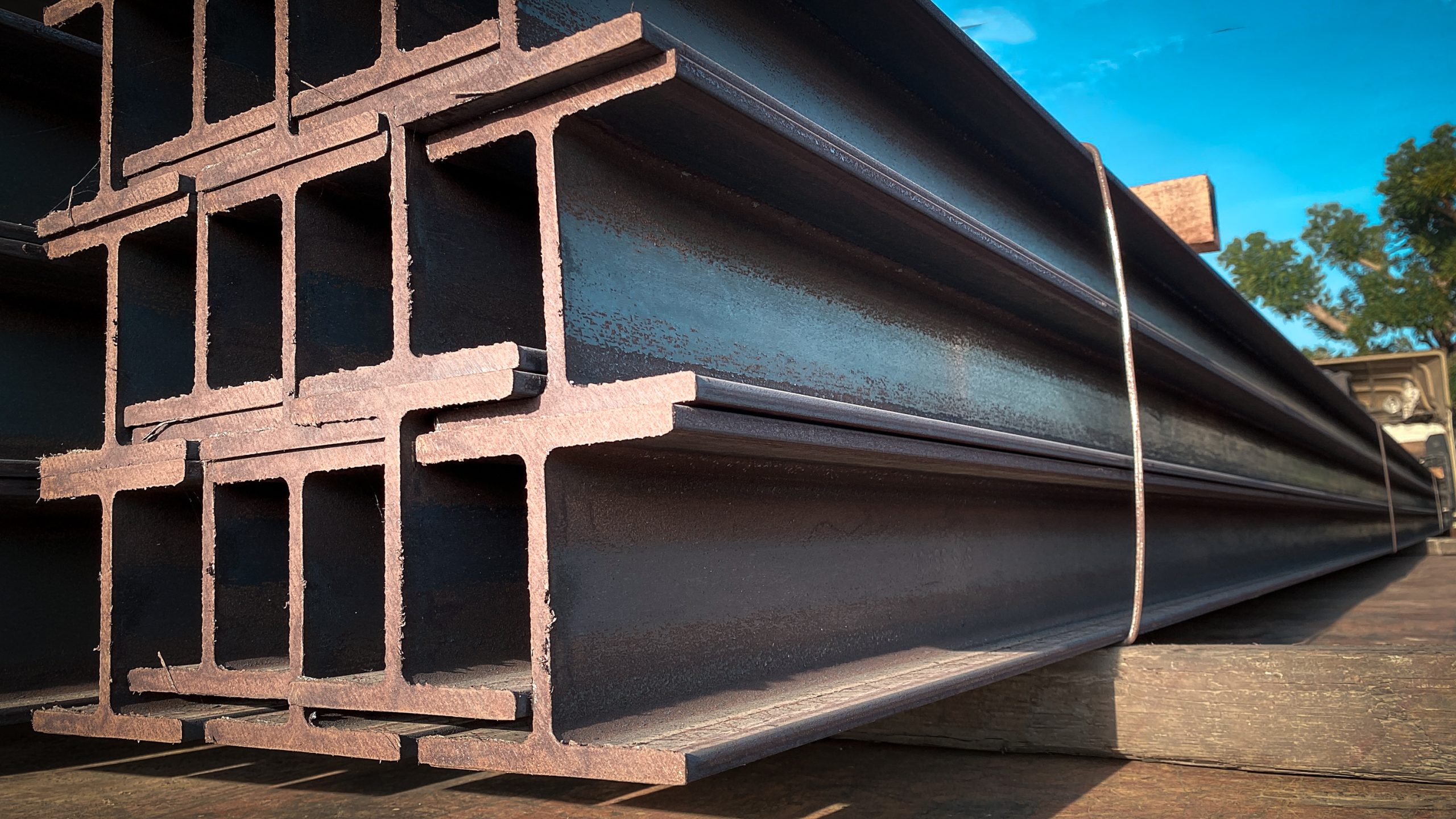
Before comparing steel beam types, it helps to understand their basic anatomy. Most I- or H-shaped steel sections have two horizontal flanges connected by a vertical web.
1. Flanges
The top and bottom portions of the beam. Their position away from the center helps the beam resist bending.
2. Web
The center plate that joins the flanges. The web helps carry shear forces through the beam.
3. Depth
The overall height of the beam from the outside of one flange to the outside of the other.
4. Flange width
The measurement across one flange.
5. Web and flange thickness
The thickness of each part of the shaped cross-section.
6. Length
The distance from one end of the beam to the other.
7. Weight per linear foot
The weight of one foot of the beam, which appears in standard beam designations.
Manufacturers roll structural sections in various shapes and dimensions to place material where it can work efficiently. That geometry contributes to a favorable strength-to-weight ratio, but it does not make every I-shaped or H-shaped beam equally strong.
Understanding I, H, S and W Beam Terminology
In everyday conversation, people often identify a beam by the letter its end profile resembles. “I-beam” and “H-beam” are useful visual descriptions, but they do not always identify one exact product.
In the U.S. construction industry, formal designations such as S and W identify standardized structural steel shapes. Other designations include M for miscellaneous shapes and HP for bearing piles. Each designation corresponds to specific dimensions and section properties.
This distinction matters when preparing a material list or requesting a quote. Two beams can have a similar shaped cross-section but different flange widths, thicknesses, weights and performance characteristics. Always use the engineer-approved specification instead of relying only on a general beam shape.
What Is an S-Beam?
An S-beam is an American Standard Beam. It has a familiar I-shaped profile, relatively narrow flanges and tapered inner flange surfaces. The transition between its web and flanges is also rounded.
S-beams are widely used for general construction and specialty applications. Depending on the approved design, they may appear in building frames, equipment, truck beds, hoists and crane systems. Their tapered flanges can affect how plates, bolts and other components fit against the beam, so connection and reinforcement details must account for the slope.
What Is a W-Beam?
W-beams are wide flange beams with wider flanges and parallel inner and outer flange surfaces. They are commonly used in modern construction because they are available in many beam sizes and can provide efficient structural support for building frames, platforms, bridges, and other applications.
The flat, parallel flange surfaces can simplify some bolted and shop-fabricated connections. W-beams are often used for columns as well as beams, but the member’s role and orientation must follow the project plans. A W shape is not automatically the right choice simply because it carries heavy loads. Capacity depends on the exact section, span, bracing, loading, and steel grade.
What Is an I-Beam?
An I-beam is generally a beam with an end profile that resembles a capital I. Some buyers use the name specifically for an S-beam with tapered inner flanges. Others use it as a broad label for several I-shaped members, including W shapes.
Because the term can mean different things, “I-beam” alone is not a complete ordering specification. Confirm whether the project requires an S, W, or another formal structural section, along with the full size and grade.
What Is an H-Beam?
An H-beam generally describes a member with broad, parallel flanges that make its end profile resemble a capital H. The depth and flange width may be closer in dimension than they are on a narrow S-beam.
However, H-beam often functions as a general description rather than a complete U.S. ordering designation. It may refer to a W shape, an HP bearing-pile shape or another product. HP shapes have their own standardized dimensions and are commonly used as load-bearing piles. Ask for the complete designation before treating “H-beam” and “wide flange beam” as identical terms.
How Do the Main Types of Steel Beams Compare?
| Beam Term | Flange Design | General Distinction | Ordering Note |
| S-beam | Narrower flanges with tapered inner surfaces | Standardized American standard beam | Use the complete S designation |
| W-beam | Wide, parallel flange surfaces | Standardized parallel-flange shape available in many sizes | Use the complete W designation |
| I-beam | Varies | Often a general description based on appearance | Confirm whether S, W or another shape is intended |
| H-beam | Usually broad and parallel | Often a visual or informal description in the U.S. | Confirm whether W, HP or another designation is intended |
How Beam Shape Affects Performance and Installation
Steel beams come in different configurations because each construction project has its own loads, spans, connections, and installation conditions. Important factors include:
Bending and shear
Flanges primarily help resist bending, while the web primarily carries shear. Exact capacity depends on the complete section and design conditions.
Connections
Parallel flanges can provide flat surfaces for certain plates and fasteners. Tapered flanges may require connection details suited to the slope.
Fabrication
Drilling, cutting and joining must follow the approved details. Proper welding and inspection can help protect the structural integrity of the finished assembly.
Weight and handling
Beam sizes and weight per foot influence transportation, lifting and crane requirements.
Durability
Steel offers high strength and long service life when it is specified and maintained correctly.
Corrosion protection
Exposure conditions, drainage, coatings, and maintenance influence corrosion. A beam’s letter designation does not provide corrosion resistance on its own.
Availability
A supplier may stock some steel beam types, lengths and grades more consistently than others.
These factors also explain why one beam cannot be called “stronger” in every situation. A deeper or heavier section may carry more load than a smaller member of the same general type. However, the structural engineer must also account for deflection, buckling, lateral bracing, connection design and the way loads enter the member.
How Do You Choose the Right Structural Beam?
The correct beam begins with the approved design. A structural engineer may consider:
- The required span and support conditions
- The amount, direction and location of loads
- Deflection and vibration limits
- Lateral bracing
- Connections and welding requirements
- Steel grade and alloy chemistry
- Compatibility with slabs, columns and other framing
- Required fire or corrosion protection
- Available lengths and fabrication needs
Together, these details help the engineer optimize the member for the structure. For example, two structural steel beams with the same nominal depth may have different weights and section properties. A beam selected for a short residential opening may not meet the project requirements for a warehouse mezzanine or a crane-supported industrial structure.
A qualified engineer should determine the beam sizing for a load-bearing structure. Eagle Steel can help identify available products and prepare material to the stated specification, but should not replace the project’s engineering.
Find Structural Beams at Eagle National Steel
Understanding the differences between S, W, I, and H beam terminology makes it easier to discuss your plans and order the specified material. The right choice depends on more than appearance; it must match the complete designation and the demands of the structure.
Eagle National Steel supplies high-quality structural beams and other structural steel products for projects throughout North Texas. We can also help you find industrial welding supplies for your work. Explore our products, contact us to place an order or visit our steel yard and showroom in Hutchins, TX.